
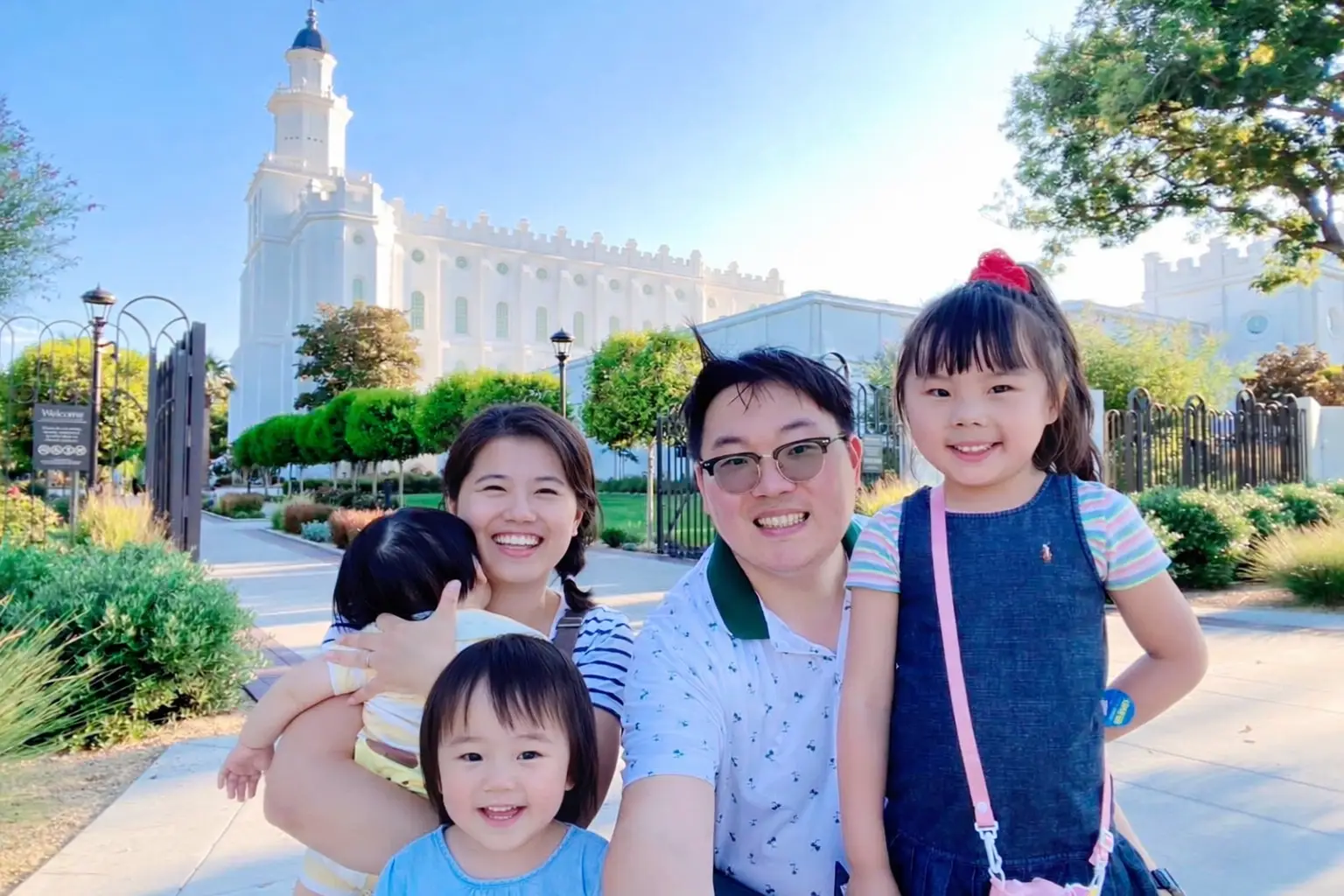
—Nina Chiu, Ridgeview 2nd Ward
Under the Spire, Peace Found Me
Whether it was the first time I entered the temple to receive my own endowment, or later when I returned to perform ordinances for those who had passed on, the moment I pushed open the door I knew—before thought and language—I was home.
I still remember the weight of that door in my hands: the quiet resistance, the steadiness of it, as if it asked me to mean what I was doing. And then the light—holy and unhurried—spilling through the windows and falling across the floor like a blessing made visible. The familiarity came so suddenly it broke through my composure; tears rose before my mind could catch up. It was not merely comfort. It was closer to déjà vu—an ancient recognition that, before I came to earth, I lived with my Heavenly Father, and I am His child.
The Lord’s promise in Kirtland Temple etched into my heart: “…my name shall be here; and I will manifest myself to my people in mercy in this house.”1 Whatever I face, something in me still longs to go home—to speak with Heavenly Father, to lay my worries before Him, and to seek His wisdom. Through these experiences, I have come to know that God lives.
Free Enough
Before I married, I worked as an art magazine editor and columnist. Once I traveled to Paris to interview the director of the Théâtre national de Chaillot about a new dance work soon to premiere. From the office window, the Eiffel Tower stood in full view—so close it felt less like a landmark than a presence.
I also carried a hope: to attend the open house of the Paris France Temple. I have always loved the humanities and the arts, and I wondered how Paris—the City of Light—would express the grandeur and sanctity of the Lord’s house through architecture and design.
But as I stepped out of the metro, my hand went to my pocket out of habit—and met only emptiness. The cash I had with me was gone: the travel budget I had saved for the three weeks I planned to spend exploring after my work was finished. I searched, retraced my steps, checked every fold and corner as if panic could create what was missing. Nothing. My excitement collapsed into dread, as if cold water had been poured over my heart.
I still had my phone. I prayed—more than once, more than I can count—and then I chose to keep my plan. When my Uber stopped outside the Paris France Temple, my
breathing finally slowed. Even if I could not solve the problem that day, I would not forfeit the chance to be in the temple.
Inside, beauty surrounded me—paintings, sculpture, hand-crafted stained glass in a classic style—yet worry lingered like a shadow I could not outrun. In the celestial room, I sat and prayed until my thoughts stopped racing.
Then a clear sentence came into my mind: “They need it more than you.”
Startled, I looked around, half-expecting to see someone speaking. My eyes searched faces, corners, the stillness itself—and then, in the next breath, I understood. The answer hadn’t come from the room at all. It had been placed in my heart.
I whispered inwardly, “Alright. I’m willing to let it go. I can earn money again as long as I keep working. But Heavenly Father—what should I do now?”
After I left the temple, I stopped before a white statue of Jesus Christ, His arms open as if in welcome—an invitation without urgency, a shelter without conditions. I studied His calm face while my own thoughts rushed. And, of all things, I thought of Claude Monet’s water lilies—how a still surface can hold both sky and depth, light and shadow at once. In my own life, the surface had just been disturbed.
Then my phone rang.
It was a friend I hadn’t spoken with in more than ten years—since college graduation, since our lives scattered in different directions. When she heard what had happened, she invited me—without hesitation—to spend the next three weeks with her family in the south of France. She met me at the TGV station and pulled me into a long embrace. When we stepped back, her eyes were bright with disbelief. We had never imagined we would meet again in a foreign place, at this exact turning in my story.
She took me into her home, cooked for me, and gave me a place to rest. She showed me castles, mountains, the coastline, and local markets—places I never would have found on my own. The days became warmer than my original plans, and far more personal.
In my heart I thanked God with quiet awe. If I had not first walked through loss, I might never have been free enough to receive that unexpected gift of friendship. Jesus Christ, who turned water into wine, can also turn the sharp thorns of ordinary life into nourishment—opening our world to possibilities we could not have planned.
Some might call this coincidence. Elder Neal A. Maxwell taught that “coincidence” is too small a word for the work of an all-knowing God: what looks random to us may be held together by divine design.2
Patience as a Bridge
Years earlier, in my romantic early twenties, a friend sent me a photo of the Salt Lake Temple surrounded by tulips. I was stunned by its beauty and holiness. I remember thinking, Could I ever marry someone I love in a place like that? I prayed over that dream—then life became busy, and I quietly forgot.
Five years later, I traveled to Hong Kong for a job interview. My schedule was full, but my heart was fuller—heavy with grief and uncertainty. Not long before that trip, I had ended a relationship. Some days, work made me feel I had chosen wisely. Other days, my grief followed me into every room. Feeling broken, I went to the Hong Kong Temple during a break, seeking God’s healing.
In the locker room, I spoke with a sister who told me her dream was to visit Temple Square in Salt Lake City. Her words stirred something in me, and that long-forgotten wish returned—fresh and tender. But I wondered, “Is it still possible?”
After the ordinance, I sat once more in the celestial room. Tears ran down my face as I poured out my frustrations and desires to Heavenly Father. I told Him that finding love is one thing. Finding love that is willing—and worthy—to be sealed in the temple is another. The circle of temple-worthy members around me felt small, and sometimes my hope felt even smaller. I was trying. I had faith. But I could not see the future.
As I took a deep breath to steady myself, that photo returned to my mind—the Salt Lake Temple surrounded by tulips—vivid as if it were placed before me again. And then I heard that voice—gentle, steady, unmistakably sure: “You will. You will be married there.”
The words stunned me. Part of me was afraid to believe them. But I chose faith anyway. I told myself—almost out loud—to be patient, as if patience were a bridge I could walk until the promise became solid ground.
A few years later, my husband and I—both Taiwanese—were sealed in the Salt Lake Temple before it closed for renovation. I can only say that it happened in ways I never could have arranged. I testify that God knows me. Once again, He turned water into wine, making possible what I had believed was beyond my reach. The
temple is not only the House of the Lord; to me it is holy ground where heaven’s answers can find me.
The Bitter Cup
And then came real life, and with it a third story—harder to tell, but truer than any I would have chosen.
Fairy tales may end with “happily ever after,” but mortal life holds joy and sorrow in the same hands. The pandemic came in the year our eldest daughter, Alisha, was born. Becoming a mother filled me with wonder, and the rising death toll of COVID 19 filled me with fear. I was grateful and anxious all at once. And then, at what felt like the worst possible time, temples closed.
The doors were shut, but I refused to let my dependence on God be shut with them. I kept reaching for heaven through prayer—because I still wanted to lean on Him. And then the tragedies arrived in waves, relentless, daring my faith to remain.
After I experienced a pulmonary embolism following vaccination, it seemed as if my immune system began a chain reaction I could not stop. I began to have miscarriages—one after another. There was the numb shock when a doctor said the baby no longer had a heartbeat. The ache of surgery. The disorientation of waking in recovery and trying to breathe through grief. The cycle repeated. Eventually I was diagnosed with an immune-system condition, and I was told I was no longer fit to be pregnant.
That news shook my faith. I felt as if I were falling into a bottomless dark well. Nightmares returned—day and night. A deep deprivation filled nearly my entire soul.
At that time, I often went to the temple grounds. I would sit quietly in a corner of the garden and look up at the spire. I held to this hope: that through the covenants we had made, the children we lost would one day be reunited with my husband and me. Sometimes I imagined what they might have looked like. Those thoughts brought me a measure of peace.
In those days I often returned to 3 Nephi 11, when the resurrected Christ declared that He had drunk “that bitter cup.”3 Reading those words, something shifted in me. I began to believe that my own bitter cup could be sanctified as I learned to submit to God’s will.
I prayed to return to the temple and feel the fullness of the Spirit again. I missed the way it felt—like invisible hands gently tapping my chest, steadying me in distress. I missed walking out of the temple feeling lighter, more capable of joy. I wanted my
faith back—not a fragile faith, but a living one. I set a goal: to face my darkness honestly, to reclaim my trust in God, and to let Him rebuild me.
Two years later, incredibly, I became pregnant again. Our second daughter, Chrissy, survived in a way I can only describe as miraculous. She fought her way through blood clots in my uterus and became my hope in flesh and bone—our miracle child.
After Chrissy, I became pregnant once more, and God entrusted us with another child, Aslan. He arrived like a quiet mercy—an added light I had not dared to ask for. It felt as if sorrow had taken so much—and then, one by one, heaven returned gifts I had stopped expecting.
Standing here now and looking back, I do not have a clever explanation—only gratitude that still catches in my throat. I thank Heavenly Father with all my heart for receiving my efforts and honoring the righteous desires I brought to Him.
I do not claim that every wound disappears. Mine is still there—scabbed over, tender, not erased. But by the grace of God, I can live with it differently now: not as someone who has forgotten pain, but as someone God has taught to carry it.
I remember President Gordon B. Hinckley’s teaching: “I encourage you to take greater advantage of this blessed privilege. It will refine your natures… [and] bring a sanctifying element into our lives and make us better men and better women.”4I also love President Russell M. Nelson’s promise: “Time in the temple will help you to think celestial… Regular temple worship will enhance the way you see yourself and how you fit into God’s magnificent plan.”5
In that sacred place, the influence of the Holy Ghost can be felt more freely as we strive to keep ourselves pure—like a temple. I share these experiences because I know God is faithful, and temple worship has changed my life. Under the spire, peace has found me, and found me again—soft as winter light sifting through the panes, gentle as a clear creek that keeps finding its way.
Notes
1 Doctrine and Covenants 110:7
2 Neal A. Maxwell, “Brim with Joy,” BYU devotional address, 1996.
3 3 Nephi 11:11
4 Gordon B. Hinckley, “Closing Remarks,” General Conference, Oct. 2004. 5 Russell M. Nelson, “Rejoice in the Gift of Priesthood Keys,” General Conference, Apr. 2024.