
By James Stevens, Canyon View Ward
“Change the way you look at things and the things you look at change.” — Wayne Dyer
Every once in a while my kids draw me an adorable picture of an animal, a house, a mountain scene, or something creative. It always makes me smile to see animals with mismatched proportions, or a house that seems to lean unnaturally. I’m sure you’ve all enjoyed cute drawings like this. If you want a good laugh, go to thingsihavedrawn.com to see how one artist is bringing drawings like this to life. When you look at these drawings it’s easy to think, “something is definitely wrong with this picture”. However, it’s usually not a lack of effort or good intentions that makes these drawings appear unnatural and unrealistic. Instead, it has more to do with the fact that they lack the application of certain true art concepts that make two dimensional drawings appear real. One of those art concepts is perspective.
Perspective is a principle in art that helps a drawing feel realistic by showing objects in relation to one another as they would appear in real life. To create perspective, an artist first chooses a focus point, called a vanishing point, and then aligns the rest of the drawing in relation to that point to create depth.
When everything is properly aligned with the vanishing point, each object naturally falls into its correct size, shape, and position. Streets, buildings, trees, faces, and animals begin to look more realistic and clear because every line and angle is connected to the same point of reference.
In the image below, a red dot marks the vanishing point of the drawing. Notice how the lines that create depth all move toward and would eventually intersect at that point. This is what creates perspective in art. Sidewalks, rooftops, windows, and everything in between relate back to the same focal point, allowing the entire scene to appear balanced and true to life.
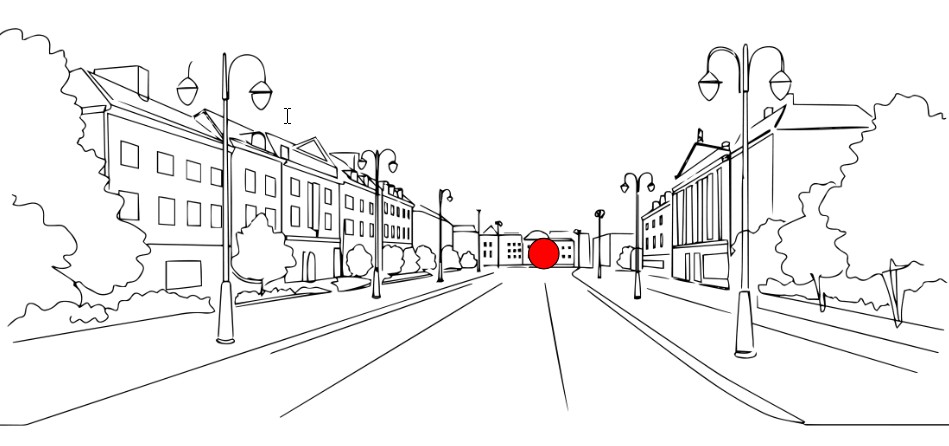
Likewise, when Jesus Christ remains the center of our lives, everything else begins to align, fall into place, and the picture of our lives becomes much clearer and easier to understand. As President Russell M. Nelson taught, “The joy we feel has little to do with the circumstances of our lives and everything to do with the focus of our lives.” Not necessarily because a Christ focused life changes the nature of the circumstances, but because it changes our perspective of how we see those circumstances. When that happens the picture becomes much clearer and we start to see the joy that is all around us.
There may be times in life when obstacles and distractions block our view of the focus point, causing us to feel confused, discouraged, or lost. In art, when the main vanishing point is hidden from view, artists can use a technique called two-point perspective. Instead of relying on one visible fixed point, they use two vanishing points to help guide the drawing and keep everything properly aligned.
In the image below, the artist is still able to create clear depth and direction even though the main focus point is obstructed. “The two vanishing points help the artist stay oriented even when the main focus point cannot be seen directly.”
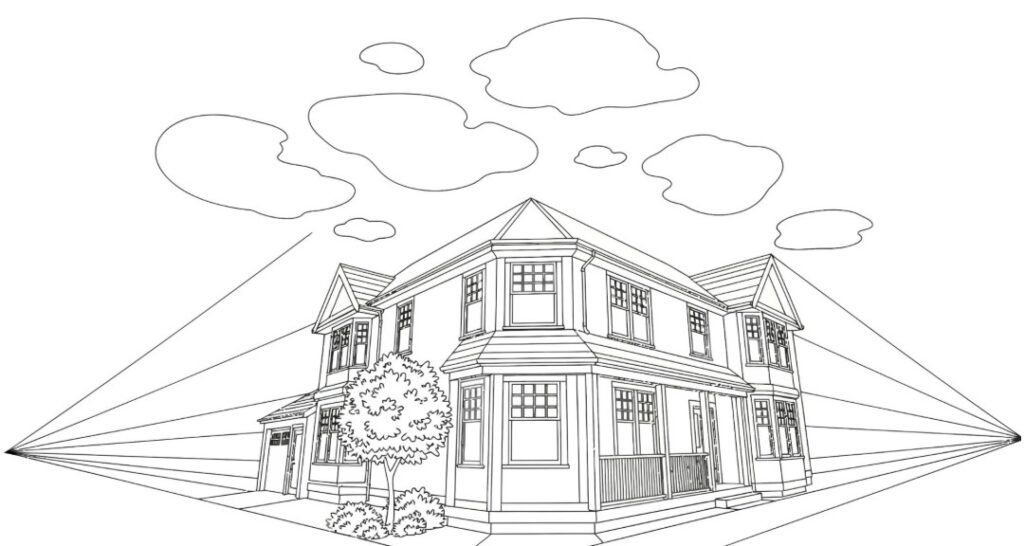
Life can work the same way. When we lose sight of the main focus point, the Lord often provides witnesses to help guide us back. These witnesses may come through scripture, prophets, the Holy Ghost, trusted leaders, friends, or family members. As we align our perspective with true witnesses, the obstacles before us become clearer, and we are better able to find our way around, over, or through them. This pattern reflects the Lord’s principle that “in the mouth of two or three witnesses shall every word be established” (2 Corinthians 13:1).
I experienced this principle personally as a young boy visiting my grandpa’s farm in Idaho. I remember standing on the edge of a large canyon next to the property. When you yell into it, your voice would echo back several seconds later. From the rim, I could clearly see all the way to the bottom where a small creek carved its way through the canyon. I could also see a trail leading down to the water. Because the path looked so clear from above, I decided to run down. The descent felt easy. There didn’t seem to be many obstacles, and I never imagined I could get lost.
But when I reached the bottom and turned around to head back, everything looked different. Large trees blocked my view, and I could no longer see the top of the canyon or the path I had come from. My perspective had completely changed. The climb back up was much harder than the climb down, and I couldn’t rely on a direct view of my destination because the obstacles around me blocked it from sight. Instead, I had to trust the worn path others had traveled before me and keep moving forward one step at a time until I finally reached a place where I could once again see the rim of the canyon clearly.
Life can feel that way sometimes. Distractions, fear, sin, or discouragement can block our spiritual perspective and make the way forward feel uncertain. In those moments, faith becomes essential. We rely on scriptures, prophets, and the guidance of the Holy Ghost to help us “see around corners” and stay on the covenant path, even when we cannot yet see the destination for ourselves. And if we realize we have wandered off course, we are not stuck. Through the redeeming power of Jesus Christ, we can repent, realign our perspective, and begin again. As we do, the obstacles begin to clear, our vision returns, and the path forward becomes visible once more.
One of the most powerful ways I’ve learned the power of applying a Christ centered perspective throughout life is through the stories of those who have lived it. Recently we celebrated my father’s 80th birthday. Instead of receiving gifts, he gave each of us something far more meaningful: It was a record of his life that he cleverly titled “The Book of Dennis, Another Testament of Jesus Christ.” I’m still praying about it to know if it’s true. (Just kidding.) Anyhow, in this family keepsake he shares many of his life experiences and all of the ways he saw Christ show up to bless his life through each experience. He has consistently kept Jesus Christ as the focus of his life and the evidence of the blessings he has received as a result is undeniable in the joy and peace he describes in his testimony at the end of the book. My Dad is a great example to me that a Christ-centered perspective becomes a legacy when it is lived and shared.In the end, no matter where we might be currently standing, and no matter how different the path we take might end up looking, the answer is always the same… Look to Jesus Christ! When we make Him the focus of our lives, He will guide us, comfort us, and help us see things as they really are. The lines of our lives begin to align, and we can finally see the picture as it was meant to be. As Camille N. Johnson recently shared, “You can do hard with Jesus, or you can do hard alone, but when you do hard with Jesus Christ, the hard becomes holy.” When we see things more clearly, we can move forward with faith, with purpose, and with joy knowing that He has marked the pathway before us to lead us home.